 Culture
WaveWorks is a company that makes mobile games and apps. Our first game, Bus Loop Escape (a puzzle about pulling buses out of a parking lot), took 9 days. Along the way we recorded 313 commits, the saved units of work in our code history. The part we redid most was the levels, and the part we touched last was release prep. Those setbacks changed the order in which we develop games.
We plan the games ourselves. Claude Code, an AI coding tool, writes the code, and Codex, another AI tool, makes the art.
Day one: the generator first
On October 3, as soon as the rules worked, we built a level generator, a program that decides how many buses go where and in which colors. The first version went in at 11:18 p.m. and produced 300 levels in one go.
It was convenient. Change one rule and all 300 came out fresh. The trouble was that the convenience let us skip actually playing them.
The same 300, four times
On October 4 we changed the rules four times.
| Time | What changed | Levels rebuilt |
|---|---|---|
| 03:04 | Generator v2: bus-count driven, reverse-escape placement | 1–300 |
| 12:00 | Passenger queue rule v3, color curve | 1–300 |
| 18:15 | Queue fixed at 150 slots, more buses and colors from level 11 | 11–150 |
| 18:28 | Queue set to 152 slots | 11–300 |
Each time, we rebuilt levels before playing a few rounds under the new rule. By the end of the day we had a batch of levels with different numbers, and we still didn’t know whether they were fun.
Bot test: 294 of 300
Two days later, at midnight on October 6, we measured the levels for the first time. A simple bot that moves whatever bus is free cleared 294 of 300. Even that simple strategy cleared almost every level.
The log from that night:
- 01:00 Added buses with hidden colors and containers.
- 01:15 The new pieces alone never produced a tense moment.
- 03:39 A bot that only looked one move ahead still cleared over 90%.
- 04:03 Switched to generator v5.
After that we added two rows to the lot and rebuilt levels 4–300, then rebuilt all 300 once more at 11:35 p.m. Had we started by measuring with a bot, most of the four rebuilds on October 4 wouldn’t have been needed.
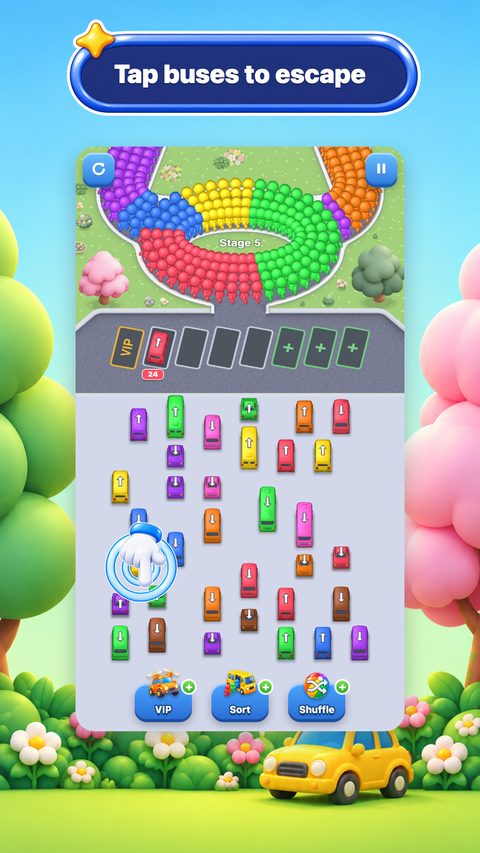
Now we build one full round, play it ourselves, and have a bot measure the difficulty before we make levels in bulk. We call this step a vertical slice: one real round, finished end to end.
Nine art swaps
October 6 also had a burst of art work. Nine commits replaced placeholder art with AI images one piece at a time: booster icons, the main menu, the shop, the loading screen, backgrounds. Close to half of the 9 days’ commits, about 145, were art and effects.
Without an art direction set in the first week, each screen got changed on its own. Now we settle art direction and key screens at the design stage and build the vertical slice in that art.
A release list on day 7
Store account approval and translations were things we could have known on day one. Yet the release to-do list was written on day 7, October 9, and the Japanese and Chinese text and store screenshots went in on October 19, the day the game went live on Google Play.
So the release sheet now comes before the game plan. On day one we write down the countries and languages, store accounts, app name, revenue model and review materials, and send off the slow account applications that day. After the release sheet come the plan, a look at similar games, art and screen design, the vertical slice, and then development.
If we did it again: Unity
We built Bus Loop Escape with web tech. It got us started fast, but keeping it smooth on budget phones and fitting every screen size kept taking work. That’s the decision we most want to change about the first game.
On October 26 we decided to move our games to Unity. New games start in Unity, and Bus Loop Escape is being moved over. The ads, payments, saving and analytics code was split out of the first game, and the next game reuses it as is.
What we don’t know yet
With one game out, we can’t use revenue or player numbers to say whether this order was right. We plan to look at the numbers 2, 4 and 8 weeks after launch and decide what to do next. Right now we’re preparing the iOS version of Bus Loop Escape and its move to Unity, and the next game started with a release sheet and is going through the vertical slice. When we get something wrong on that one, we’ll write it up here with the date.