 Culture
When our first game, the bus puzzle Bus Loop Escape, went live on Google Play on October 19, it supported two languages: English and Korean. That afternoon we decided to add Japanese and Traditional Chinese. By night we had built version 1.0.2 with five languages, Simplified Chinese included.
WaveWorks is a company that makes mobile games and apps. We decide what to make, and the code and art are built with the AI tools Claude Code and Codex. Claude wrote the translation drafts too. Localization here covers the game’s text, its store listing and its product names, adapted for each language.
Two languages on launch day
Our language plan from October 9 was to launch worldwide with English as the base language. There’s no language menu in the game; it follows the phone’s language setting. At launch, phones set to Korean showed Korean, and all others showed English.
That meant someone using their phone in Japanese or Chinese got English screens. Simplified Chinese came in partway through the Japanese and Traditional Chinese work.
Text and screenshots outside the game
Here’s the commit log from that evening.
| Time | What went in |
|---|---|
| 17:17 | Japanese and Traditional Chinese game text and game names |
| 18:55 | Simplified Chinese |
| 21:10 | Draft Japanese and Chinese store copy |
| 21:21 | In-app products and screenshot scripts extended to the new languages |
| 22:38 | Japanese and Chinese screenshots composited |
| 22:53 | Version 1.0.2 |
Translating the game screens wasn’t enough. Each language also needed its own store title, description, in-app product names and screenshots. We created 72 localized store screenshots for the new languages.
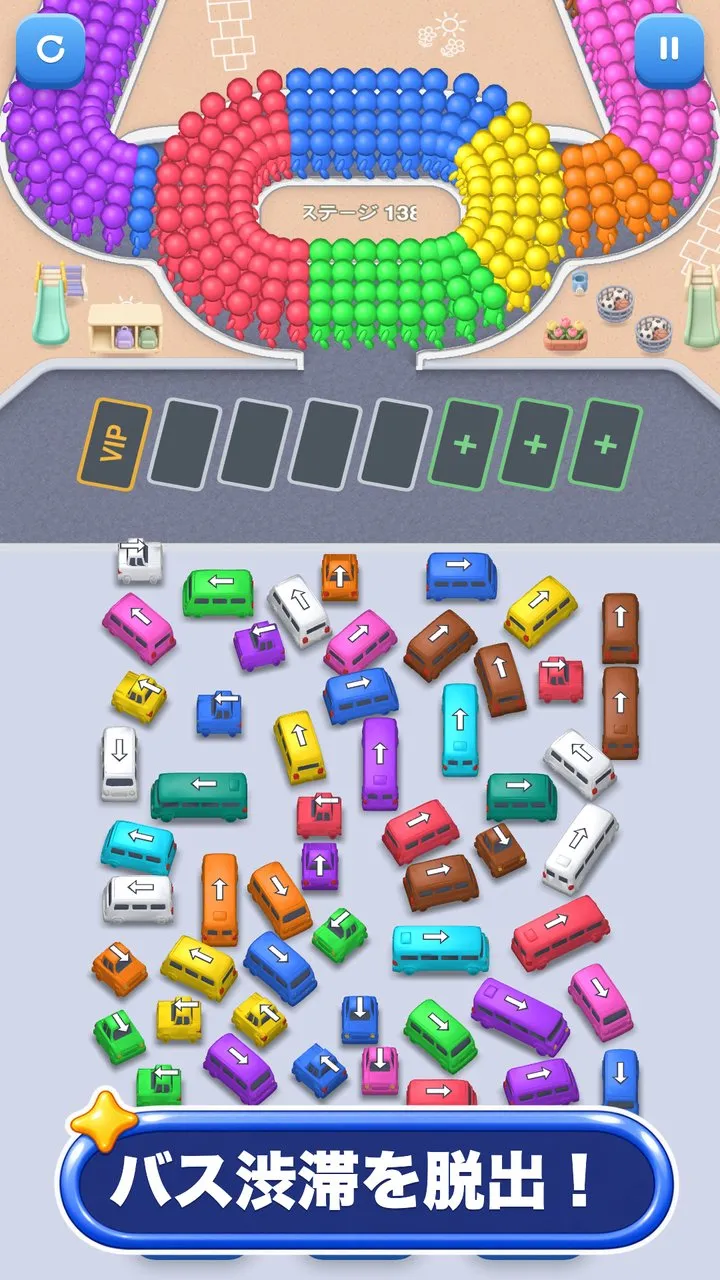
The game got a new name in each language: スクールバス大脱出 in Japanese, 校車大逃脫 in Traditional Chinese, 校车大逃脱 in Simplified Chinese. Each store title also names the genre, like “バス脱出パズル” (bus escape puzzle) in Japanese. Version 1.0.2 went public on October 23, and we entered the Japanese and Chinese store listings on October 25.
Kanji in a Korean font
Once the translations were in, the Han characters in Japanese and Traditional Chinese showed up in Korean glyph shapes. Each language draws the same character a little differently, and the game was reaching for the Korean font first. We fixed it by putting Hiragino Sans ahead of the Korean font for Japanese, and PingFang TC for Traditional Chinese.
Chinese also needed a new rule for reading the phone’s language. Before Simplified Chinese was in, we showed Simplified readers English so they wouldn’t get Traditional characters. After it went in, Taiwan, Hong Kong and Macau settings, or any setting marked Traditional, get Traditional Chinese, and every other Chinese setting gets Simplified.
Japanese product names that overflow
Translated text changes length. Three Japanese product names (上級, 達人 and 究極バンドル) and the titles of the daily login reward and gas station screens spilled out of their boxes, so we shortened them. The line break on the day 7 attendance tile got fixed when Simplified Chinese went in.
To keep this from happening again, we added a check. It opens each Japanese and Chinese screen in turn and confirms that no Korean characters remain and no text runs past its box.
A different app name per language
Our next app, the baby log Oh My Baby, had five languages from the start. We had the option of translating the name word for word, but we went with names that describe what the app does: オーマイベビー:赤ちゃん育児日記 in Japanese and Oh My Baby:宝宝成长记录 in Simplified Chinese.
“Oh My Baby” was already taken on the App Store, so English and Chinese use the full title with the description. Under the home screen icon, a Korean phone shows 오 마이 베이비 and any other phone shows Oh My Baby. We had Codex review the five-language text once more, which led to 64 fixes, and automated tests check that nothing overflows on a 360-pixel-wide screen.
Translations still in draft
The Japanese and Chinese text in both apps is a draft that native speakers haven’t reviewed yet. For Oh My Baby, we decided to get that review after launch. If something reads oddly, tell us through Contact and we’ll check it and fix it.
More languages are coming. The company plan set on October 19 keeps these five as the base, then adds German, French, Spanish and Brazilian Portuguese, then Indonesian, for ten in total. Bus Loop Escape, which we’re moving to Unity, already has a ten-language text table, and we shortened the “No ads” label where it overflowed in German, French, Spanish and Portuguese. Supporting a language and releasing in that country’s store are separate decisions, and we’re holding off on mainland China for now.